Laugavegur river crossings: where they are and how to cross safely
Which rivers you have to wade on the Laugavegur Trail, which ones have bridges, what to wear on your feet and how to cross glacial rivers safely.
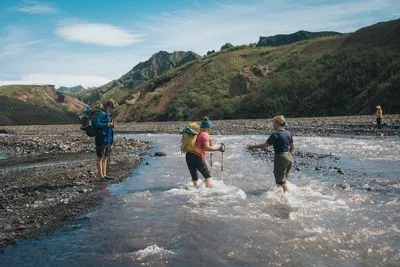
For many hikers the river crossings are the part of the Laugavegur they’re most nervous about. In normal summer conditions they’re cold, a little exciting, and very doable. But glacial rivers change quickly, so it pays to know what to expect.
Which rivers do you wade?
Ferðafélag Íslands says you’ll have to wade at least three rivers. Walking north to south:
| River | Where | What to expect |
|---|---|---|
| Grashagakvísl | Day 2, just before Álftavatn | Usually shallow. Early in the season there may still be snow bridges. Don’t trust them. |
| Bratthálskvísl | Day 3, just after Álftavatn | Short, usually ankle- to knee-deep. |
| Bláfjallakvísl | Day 3, between Hvanngil and Emstrur | The widest crossing; knee-deep, can be higher after rain. |
| Þröngá | Day 4, just before Þórsmörk | The last ford. Can be fast and is risky after heavy rain. |
Rivers with a bridge
You don’t have to wade the Kaldaklofskvísl (footbridge near Hvanngil), the Innri- and Fremri-Emstruá (footbridges over a deep gorge near Emstrur), or the Krossá in Þórsmörk if you use the footbridge. Never try to wade the Krossá: it’s notorious for sweeping away even 4×4 vehicles.
What to wear on your feet
- Sandals with a heel strap or old trail shoes. Never cross barefoot: the riverbed is rocky and the water is too cold to feel your feet.
- Neoprene socks make a huge difference against the cold.
- A small towel to dry off before you put your boots back on.
How to cross safely
- Look before you leap. Find the widest point: wide water is usually shallow and slower. Look for the marker poles on both banks.
- Unbuckle your hip belt and chest strap, so you can slip out of your pack if you fall.
- Use your poles. Face upstream or walk slightly diagonally downstream, moving one point at a time: two feet and one pole, or two poles and one foot, always on the riverbed.
- Cross together. Link arms in a line or a triangle. Groups are far more stable than individuals.
- Go early. Glacial rivers rise during the day as the sun melts the ice. Morning crossings are usually lower.
- If in doubt, wait. After heavy rain, levels can drop again within hours. Ask the hut warden about conditions before you leave.
Rule of thumb: if the water reaches above your knees and is flowing fast, don’t cross. Turn back or wait.
After the crossing
Shake off, dry your feet, put on dry socks and keep moving to warm up. A thermos of hot drink at the start of the day is a luxury you won’t regret.